
BEAP & Computer-Assisted Learning
The Benishangul-Gumuz Education Acceleration Programme: a four-year pilot strengthening literacy and numeracy in government primary schools through Teaching at the Right Level and computer-assisted learning initiatives.
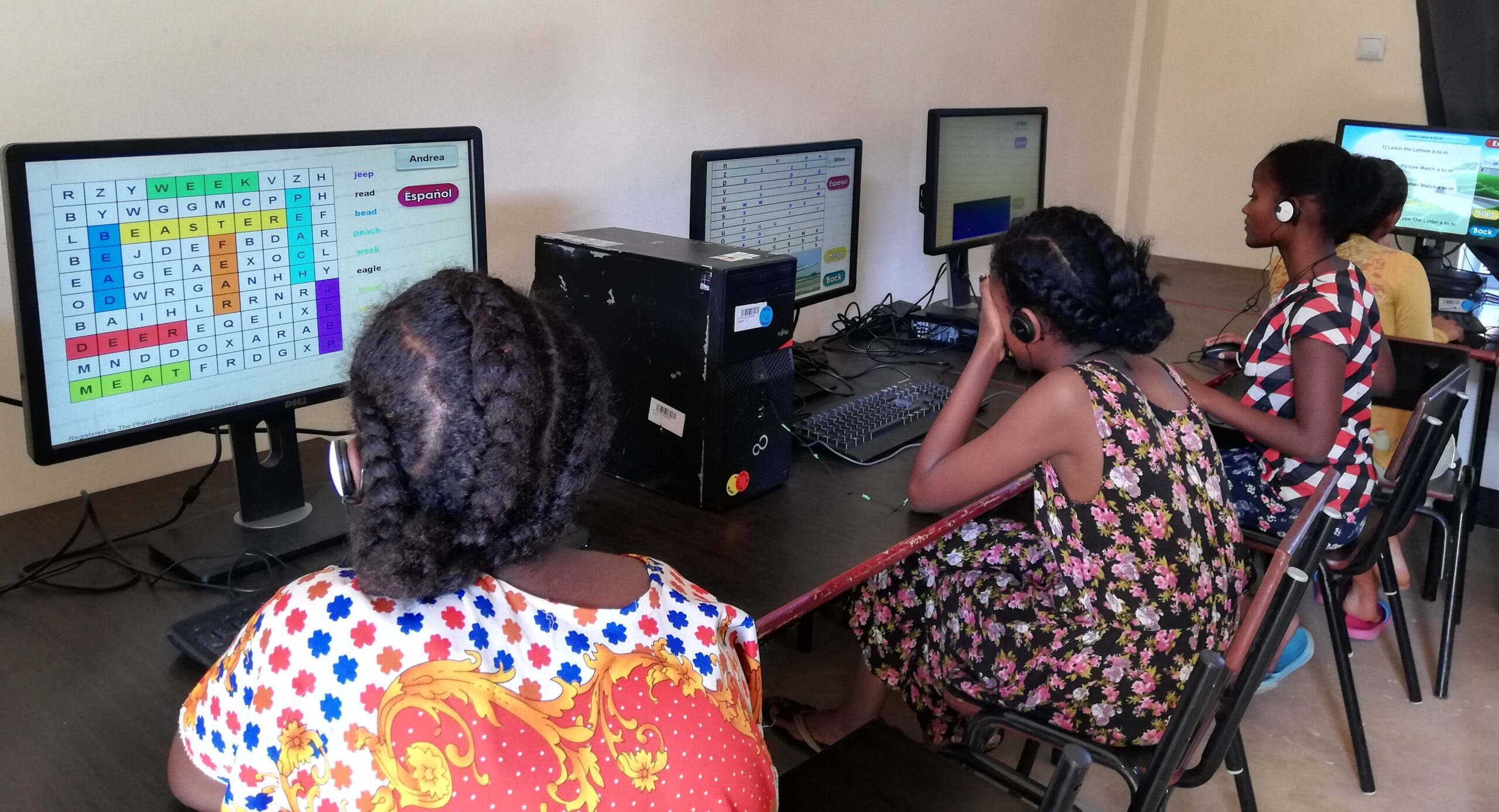
Computer-assisted English lesson, Assosa Primary School, Benishangul-Gumuz.
Raising the floor in public schools, not just our own.
BEAP works inside government primary schools in Benishangul-Gumuz, one of Ethiopia’s most underserved regions, pairing a proven structured-pedagogy method, Teaching at the Right Level, with computer-assisted learning to lift results in literacy, numeracy and core subjects.
Running in Benishangul and Homosha Primary Schools across grades 1 to 8, the programme tailors instruction to each child’s actual learning level rather than the year they sit in. A 22-station computer lab at Assosa Primary, connected to a teacher-controlled server, gives pupils access to thousands of interactive digital resources, delivered in partnership with CAMARA Education Ethiopia.
It is a deliberate complement to our own Pharo School Assosa and Homosha Girls’ Boarding School: a test of whether the same standards can be reached in the public system, at a cost a government could one day carry.
A region where years in school did not mean learning.
Across Benishangul-Gumuz, enrolment has risen, but learning has lagged. Public primary pupils, girls especially, fall below national benchmarks in English, mathematics and general science, and the gender parity index sits at roughly 0.86. COVID-19 widened the gap further: foundational numeracy among Ethiopian Grade 1 pupils fell by around 15 percentage points after school closures, with poorer and rural regions hit hardest. Another issue was a wide range of competencies in one grade or class. The teachers needed training and materials to assist them in teaching multiple learning levels within the same class room.
Working with the regional education bureau, we traced the gap to three causes we could actually move: weak teacher competency, outdated one-size-fits-all pedagogy, and thin teaching and learning materials with almost no digital provision.
Our response
We chose structured pedagogy over alternatives like school feeding because the evidence said it would move test scores furthest per dollar, then built it around four reinforcing activities.
Teaching at the Right Level
The structured-pedagogy method pioneered by Pratham: assess each child, group by learning level, and teach to it, rather than to the curriculum year.
Computer-assisted learning
A 22-station lab at Assosa Primary on an open-source CAMARA platform, with interactive maths and science content and live assessment, piloted in grades 7 and 8.
Teacher training and coaching
61 teachers trained across the two schools, supported by 16 mentors and 12 school leaders and supervisors trained to embed the approach.
After-school instruction
Remedial sessions six days a week, including Saturdays, led by teachers and trained university-graduate interns.
Our impact
Early results from the pilot, reported against historic baselines.
What we learnt
Method beats inputs.
Our own cost-effectiveness analysis put structured pedagogy roughly eight times ahead of a school-feeding programme on test-score improvement per dollar, the evidence that shaped the design.
Technology lifts public schools.
Computer-assisted learning produced a historic jump in Grade 8 pass rates at Assosa Primary, a model worth extending once it has a clear long-term owner.
Build for handover.
The materials and trained teachers are fixed costs that a regional government could later reuse across other public schools, which is the point of running it as a demonstration.
Help take computer-assisted learning to more public schools.
BEAP is a pilot built to be handed over. Partnership and co-funding enquiries to extend it across Benishangul-Gumuz start here.