
Vocational Training Centre, Hargeisa
Technical and vocational training in Hargeisa with direct job linkages to the construction sector.
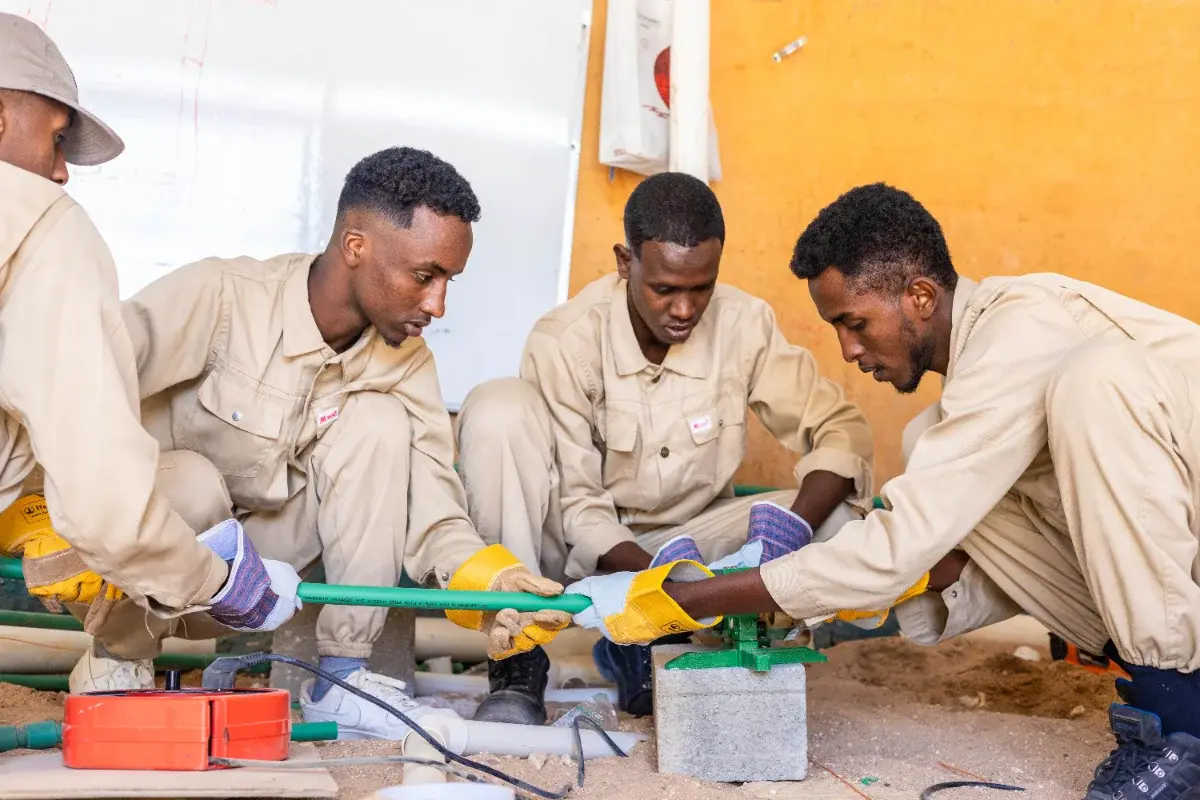
Vocational Training Centre, Hargeisa, Somaliland.
Skills with a direct line to work.
Our Vocational Training Centre in Hargeisa trains students in construction-relevant trades and links them directly to employers through an internship phase.
The Centre opened as a pilot with two demand-led courses, painting and decoration for school-leavers and engineering surveying for graduates, chosen after interviews with construction firms and universities in Hargeisa. Since 2022, Pharo Vocational Training Centre in Hargeisa has trained a total of <strong>450 graduates</strong>, including <strong>348 core programme graduates across five cohorts</strong> and <strong>100 completed partner-funded graduates</strong>. The programme covers three market-relevant trades: <strong>Electrical Installation & Solar Energy, Painting & Gypsum Board Decoration, and Plumbing & Pipe Fitting</strong>.
Among fully tracked alumni from Cohorts 1–4, <strong>78% are engaged in productive activity</strong>, including employment, self-employment, or university education. The current graduating cohort has also shown strong labour market demand, with <strong>34 trainees from cohort 5 securing jobs before official graduation</strong>.
Through partnerships with SOS Children’s Villages, Muslim Hands, and Save the Children, Pharo VTC continues to expand access to practical skills training for young people.
Training without jobs leaves people no better off.
Somaliland’s construction sector is among its fastest-growing, yet firms rely on skilled labour imported from Dubai and China because too few local workers are trained to standard. Existing vocational programmes are under-resourced, rarely linked to employers, and often leave graduates treated as unskilled labour. Training that ignores the labour market produces qualifications without employment, and the link to employers is the point.
Our response
Train in the trades the construction sector actually needs, then connect students directly to the employers who need them.
Demand-led trades
Courses such as painting and decoration and engineering surveying, chosen from interviews with construction firms and universities.
Employer mapping
A comprehensive exercise securing 36 host companies across construction, renewable energy and water utilities.
Internship phase
Placing students with employers for real, on-the-job experience that leads to work.
Our impact
2025 figures, reported in the annual report.
What we learnt
Demand is fragmented.
Household demand for trades is fragmented and the student base is financially constrained, with willingness to pay outstripping ability.
Employers make it work.
Direct employer linkages, not classroom hours alone, are what turn training into jobs.
Replace imported labour.
Firms were sourcing skilled workers from abroad; training locally keeps both the wages and the skills in Somaliland.
Build the skills pipeline.
Partnership, co-funding and operator enquiries start here.