
Pharo Dams
Climate-resilient water infrastructure in Somaliland: hafir dams that capture and store water for communities and livestock.
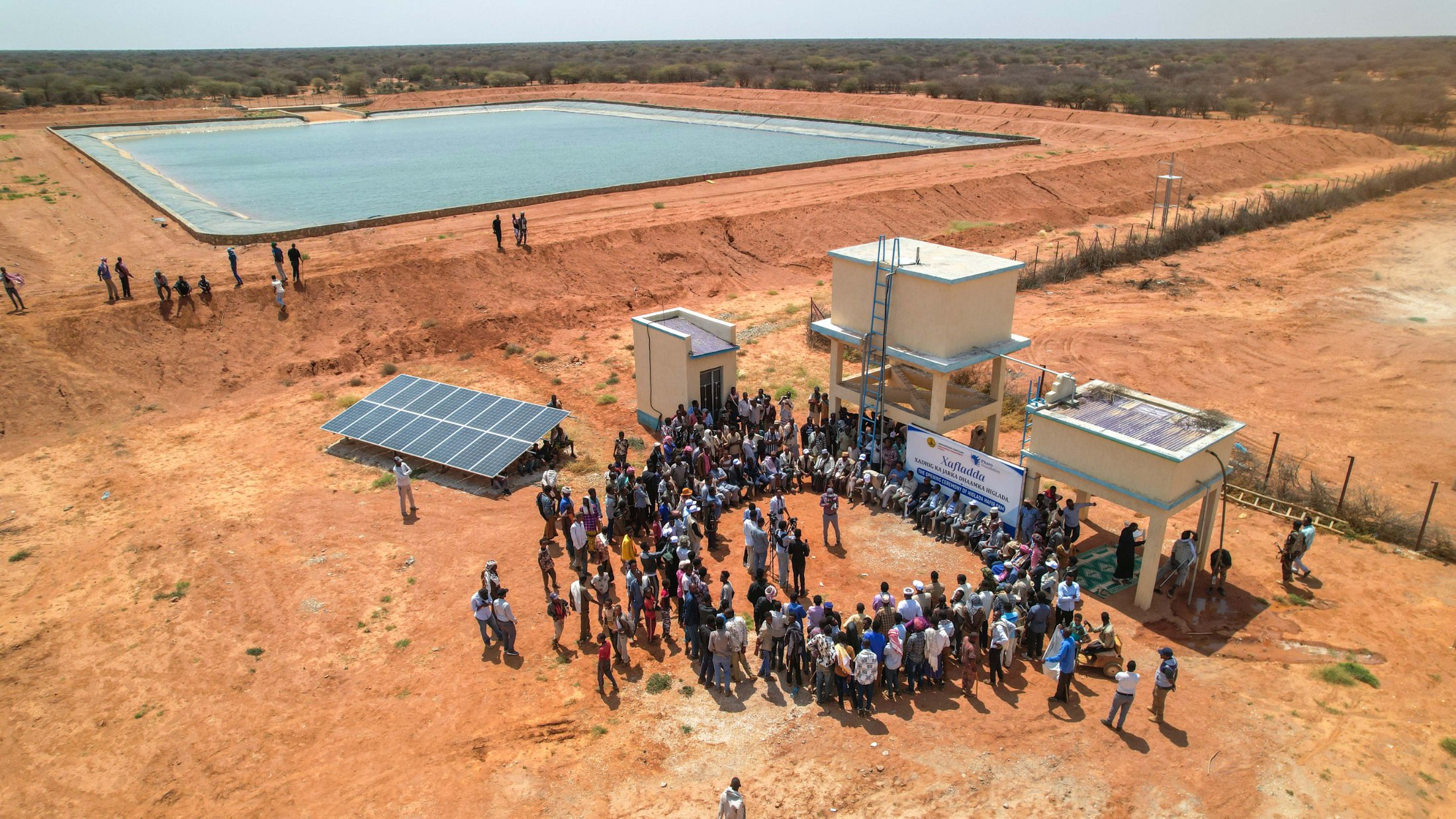
Opening ceremony of Higlada hafir dam, Somaliland.
Stable water makes everything else possible.
Pharo builds and rehabilitates hafir dams across the drought-exposed landscapes of Somaliland, so communities can plan beyond the next rainfall.
By 2025, we had built a network of hafir dams, large seasonal public reservoirs, with a combined capacity of around 319,600 m³. Individual dams such as Wado-Makahil (58,000 m³) are a good example of how we build these dams. Reinforced with silt traps and geomembrane liners, and a day or two of rain can fill a dam for use through the dry months. Separate taps and troughs give people and livestock safer, more reliable access.
Our dams are carefully thought out and planned to ensure that they are built in the best area for widespread access.
From 2026, the focus is shifting toward rehabilitation, guided by satellite mapping of over 1,000 hafir dams and 1,200 berkeds, and by on-site monitoring of how each one actually performs.
When water is uncertain, nothing else can be planned.
Erratic rainfall and persistent drought leave households and herds without a reliable supply and infrastructure. Existing dams built without monitoring frameworks have failed and dried up quietly, rendering many of them useless. There are dams around, but many are not functional.
Our response
Capture and store water with infrastructure sized to the catchment, designed with the community, and increasingly rehabilitated rather than rebuilt.
Our impact
2025 figures, reported in the annual report.
What we learnt
Design determines efficiency.
Dams with geomembranes, silt traps and security, plus strong site management, were markedly more efficient.
Rehabilitation beats new build.
Restoring existing dams improved our impact per dollar, and one rebuilt dam (Biyo) showed that liner quality makes or breaks performance.
Site for the catchment.
Satellite analysis showed many existing dams were not sited to capture natural runoff, so where a dam sits matters as much as how it is built.
Co-fund water resilience.
Partnership, co-funding and operator enquiries start here.